

[5 min read]
In this article:
- Mike Boyle and his daughter were on the road home from SeaTac when his heart stopped for 90 seconds, leaving him unconscious for seven minutes.
- Medics took Boyle to Providence Swedish Cherry Hill, where he was diagnosed with a rare but treatable heart condition and fitted with a pacemaker.
- Boyle was so impressed with his care that he wrote a letter to the Seattle Times and made a generous donation to the Providence Swedish Heart and Vascular Institute, to help ensure that lifesaving care is there for other patients when they need it.
- Today, Boyle is on the road to recovery and getting back to good health and a life and family that he loves.
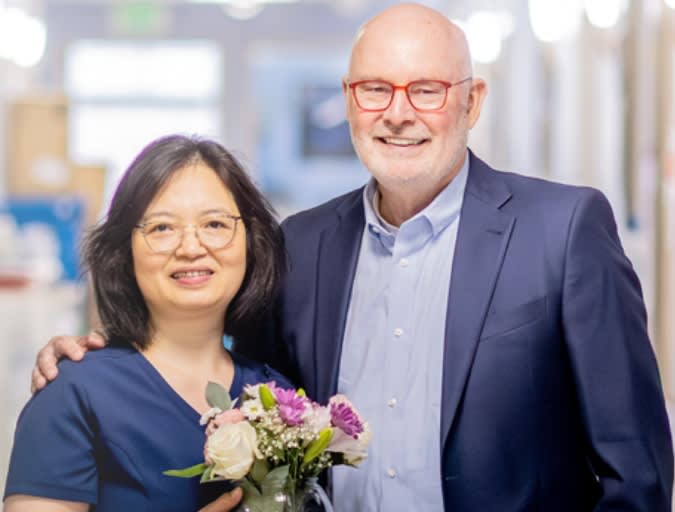
Tears fill Mike Boyle’s eyes as he looks around Providence Swedish’s Cardiovascular Intensive Care Unit. One year after surviving cardiac arrest, he’s back — this time standing alongside Alice Yuesheng Qin, RN, (shown in photo above) the nurse whose immediate CPR saved his life. Overwhelmed with gratitude, Boyle hands Qin a bouquet of flowers.
“If it wasn’t for you,” he says, “I wouldn’t be standing here today.”
A crisis at 50 miles per hour
Boyle's cardiac symptoms began unexpectedly in April 2025 during his routine morning jog in San Diego, where he and his wife keep a second home. At 68 years old, he followed a healthy diet and exercised regularly, often jogging around Green Lake in Seattle and playing full-court basketball. He had no family history of heart disease and had never experienced any cardiac concerns himself, so he wasn’t too worried when he started feeling dizzy and out of breath. But after a few days of the same symptoms, Boyle returned to Seattle to discuss his symptoms with his primary care provider.
His doctor performed an electrocardiogram (EKG) which detected an irregular heartbeat. Boyle was fitted with a Holter heart monitor to continue tracking his heartbeat and told to return in four days.
“I feel very, very grateful that I’m still here. And I strongly recommend Providence Swedish Cherry Hill to anyone who needs heart care.”
Wearing his heart monitor two days later, he drove to the Seattle-Tacoma International Airport to pick up his daughter, Lizzie (shown in photo below at right), who was visiting from Los Angeles. They were headed home, driving 50 miles per hour on State Route 99, when Boyle suddenly felt dizzy. He doesn’t remember what happened next.
“I thought, ‘Oh my God, did I just watch my dad die?’” Lizzie says.
“Dad suddenly called out, and I saw his body stiffen as he pushed back against the steering wheel,” Lizzie recalls. “He was shaking but managed to get all the way from the far-left lane to the shoulder on the right side of the road.”
That’s when Boyle stopped the car and slumped forward, unconscious.
“I thought, ‘Oh my God, did I just watch my dad die?’” Lizzie says. 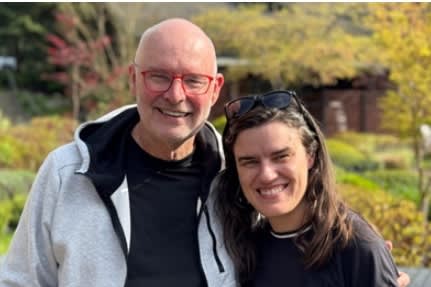
Boyle was unconscious for seven minutes before his head jerked up. He saw his daughter on the phone with a 911 operator, but he had no idea what had happened or how he’d stopped the car. Days later, doctors would review Boyle's heart monitor and saw that his heart had stopped for a minute and a half.
The fire department and medics arrived minutes later and helped Boyle into an ambulance.
“They told me we were going to Providence Swedish Cherry Hill, because it was the best cardiac care center in the city,” he remembers.
Boyle arrived at the Emergency Department and was quickly transferred to the CVICU, where his heart continued to stop for periods of 10 to 20 seconds. The next day, with his wife and children at his bedside, Boyle passed out again and his heart monitor flatlined. His wife and daughter opened the door to find help and saw a group of nurses sprinting toward the room.
“It was one of the scariest moments of my life,” Lizzie says.
For nearly 10 minutes, Qin and the care team performed CPR on Mike. Once his pulse was restored, Mike was rushed to the cardiac catheterization lab where the team placed a wire connected to an external temporary pacemaker. It was replaced with a permanent pacemaker two days later.
The road to recovery
Caregivers later determined Boyle had cardiac sarcoidosis, a rare inflammatory condition where immune cells form granulomas (clumps) in the heart muscle. These clumps and subsequent scarring interfere with the heart’s ability to pump blood. It can be a life-threatening condition but is treatable. Fortunately, Providence Swedish Heart & Vascular Institute (PSHVI) has a cardiac sarcoidosis expert — Lee Chang, M.D. — who manages Boyle's care to this day. Dr. Chang prescribed medications that have effectively treated the condition.
While he continues to recover, Boyle is taking long walks and slowly starting to jog again. Over the summer he and his wife completed a three-day 40-mile walk in Ireland. More recently he flew to San Diego to attend his stepson’s wedding.
“I feel very, very grateful that I’m still here,” he says. “And I strongly recommend Providence Swedish Cherry Hill to anyone who needs heart care.”
Driven by gratitude
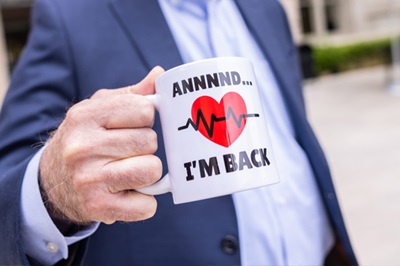
This fall, Mike expressed his appreciation for Providence Swedish in two generous ways. First, he wrote a letter to the Seattle Times raving about the CVICU nurses who saved his life. Second, he made a generous donation to PSHVI.
“I believe in philanthropy and giving back,” says Boyle. “I want to do everything I can to support the team who saved my life.”
Learn more and find a physician or advanced practice clinician (APC)
The team of specialists at the Providence Swedish Heart & Vascular Institute has access to the latest treatments and technology and the expertise to know how to use it safely and effectively. Call 206-320-4100 to learn more about the vascular care we offer.
Whether you require an in-person visit or want to consult a doctor virtually, you have options. Contact Swedish Primary Care to schedule an appointment with a primary care physician. You can also connect virtually with your doctor to review your symptoms, provide instruction and follow up as needed. And with Swedish ExpressCare Virtual, you can receive treatment in minutes for common conditions such as colds, flu, urinary tract infections and more. You can use our provider directory to find a specialist or primary care physician near you.
About the Swedish Foundation
Your generous gift helps support a healthy tomorrow for everyone in every community we serve. Learn about more ways to give to the Swedish Foundation or make a direct donation online at swedishfoundation.org. You can also contact the Foundation at 206-368-2738 or email foundation@swedish.org. Thank you for helping us shape the future of healthcare. We can’t do it without you.
Information for patients and visitors
Additional resources
“You are going to get the TLC you need from this team. It’s world-class care.”
A life saved at the gym: How quick action, CPR and AED made the difference
A doctor's persistence and a daughter's love saved this Seattle dad's life
The Providence Swedish Heart & Vascular Institute is transforming cardiovascular care
This information is not intended as a substitute for professional medical care. Always follow your healthcare professional's instructions.
The Providence app offers world-class health care with human connection
Follow us on Facebook, Instagram and X.
About the Author
More Content by Swedish Heart & Vascular Team


