


[5 min read]
In this article :
- Providence Swedish is home to the nation's premier center for Multiple Sclerosis care.
- When Phil, a Providence Swedish MS patient, was diagnosed he refused to accept that he might never play music again. He re-learned how to play his guitar.
- In 2015, Phil launched "Get Your Music Back", a program that helps patients with MS recover dexterity with their musical instruments.
- The generosity of donors to the Swedish Foundation makes the program and many others like it possible at Providence Swedish.
“I want everybody to have hope, because once you have hope, you have power.”
This is the mission of Phil, a volunteer at Providence Swedish Multiple Sclerosis (MS) Center, helping musicians with neurologic conditions learn to overcome difficulties playing their instruments and experience the healing effects of music.
In 2002, Phil’s life changed dramatically. He was working in public health research and loved playing guitar, piano, and other instruments in his free time. One day, Phil was pouring himself a glass of water when his right ear started ringing and the left side of his body felt numb. Over the next few hours, the muscles on the left side of Phil’s body grew weaker. His wife, Susan, insisted they go to the emergency department. After a series of tests, doctors told Phil he had MS.
MS is a disease with no known cause or cure. It causes the body’s immune system to attack the brain and spinal cord, which make up the central nervous system. When this occurs, signals from the brain to the rest of the body are disrupted. This disruption of signals results in symptoms that can include numbness, tingling, pain, fatigue, changes in mood, memory problems, blindness, and paralysis.
Phil’s diagnosing physician explained that while the progression of MS varies, he was unlikely to regain strength on his left side.
Phil and his wife went home from the hospital, planning to seek a second opinion. The next day he picked up his guitar and tried to play but could no longer depress the strings or form chords with his left hand.
“I couldn’t accept that,” Phil says. “Music has always been a part of my life, and I was not about to give it up.”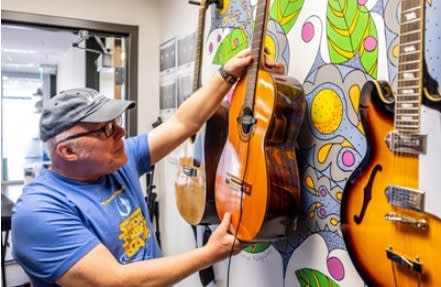
That’s when Phil (shown at right with guitars) thought about his dad, who was born with cerebral palsy but was determined to play his family’s piano, despite the fact that the disease kept his hands in a clenched position.
“He taught himself to play notes using the first knuckle of each thumb and eventually his hands opened up, and he developed full use of his fingers,” Phil says. “I thought, if he can teach himself to play, then I can get my ability back.”
Phil set small, attainable goals for himself and after 10 months of persistence, he regained his strength and dexterity. Today, Phil says he’s a better musician than he was before his diagnosis.
“Our brains are really dynamic,” Phil says. “They can heal and create new pathways. It’s amazing. I call it a superpower.”
Thrilled to be playing music again, Phil wanted other people with neurological conditions to know how they, too, might be able to regain lost abilities. In 2015, he reached out to Providence Swedish MS Center, which serves a third of MS patients in the Pacific Northwest, and offered to help others just like him recover musical dexterity with their instruments. Leaders at the MS Center readily agreed, and Phil launched the Get Back Your Music program that year.
Over the years, Phil formed a band called Axon with Get Back Your Music participants. They were featured in a 2020 documentary called "Looking Inward". In the film, Axon drummer Patty Padden (at right) says, “When I play the drums, I come into the room limping. It takes me 15 minutes to get off my scooter and behind my drum set, and we start playing rock and roll and blues and within a few minutes I’m not thinking about my MS.”
“Phil has helped many patients overcome assumptions about what their disease has taken from them,” says Pavle Repovic, M.D., Ph.D., medical director of the MS Center. “He’s helping them discover what they still can do.”
Find a physician or advanced practice clinician (APC)
If you have questions about multiple sclerosis, contact the Swedish MS Center. We can accommodate both in-person and virtual visits.
Our experts at the Swedish Neuroscience Institute offer comprehensive, progressive diagnosis and treatment for a wide range of spine, brain and central nervous system conditions. Telehealth options are available. Visit us on the web or call 206-320-3940. You can also use our provider directory to find the doctor that’s right for you.
Swedish Virtual Care connects you face-to-face with a nurse practitioner who can review your symptoms, provide instruction, and follow up as needed. If you need to find a provider, you can use our provider directory.
About the Swedish Foundation
Your generous gift helps support a healthy tomorrow for everyone in every community we serve. Learn about more ways to give to the Swedish Foundation or make a direct donation online at swedishfoundation.org. You can also contact the Foundation at 206-368-2738 or email foundation@swedish.org. Thank you for helping us shape the future of healthcare. We can’t do it without you.
Information for patients and visitors
Additional resources
After an MS diagnosis, this sailor charted a new course
The Swedish MS Center: New leadership committed to our tradition of visionary care
A promising advance in the treatment of Huntington’s Disease
This information is not intended as a substitute for professional medical care. Always follow your health care professional’s instructions.
The Providence app offers world-class health care with human connection
Follow us on Facebook, Instagram and X.
About the Author
More Content by Swedish Neuroscience Team


