

[5 min read]
In this article:
- Lung cancer is the leading cause of cancer deaths in the United States, claiming an average of 361 lives per day. Early diagnosis is essential for developing the most effective treatment plan and better outcomes.
- Robotic bronchoscopy is a minimally invasive procedure that uses CT scans and navigational technology to access hard-to-reach areas of the lungs for more precise, and often real-time, diagnosis of lung cancer.
- Swedish care cancer and interventional pulmonology experts are committed to collaborative, tailored care for every patinet with lung cancer at Providence Swedish. Learn more about the technology and the future of care for lung cancer at Providence Swedish.
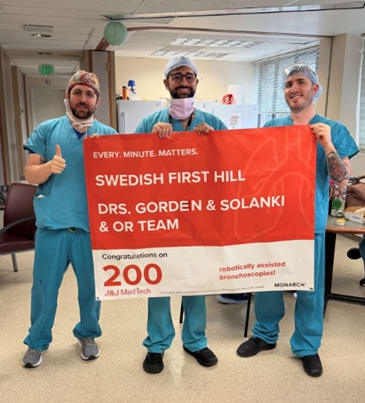
In early March, Providence Swedish care teams reached a major milestone in the diagnosis and treatment of lung cancer: thoracic oncology and interventional pulmonology teams performed their 200th robotic navigational bronchoscopy—a minimally invasive procedure that uses advanced technology to access hard-to-reach areas of the lungs. Robotic bronchoscopy allows for more precise biopsy of pulmonary nodules and, in many cases, real-time diagnosis of lung cancer.
“The technology allows us to navigate inside the lungs and significantly expand our reach, enabling us to biopsy nearly all suspicious pulmonary nodules. Some of these nodules would be difficult to reach from the outside safely via CT-guided biopsy, especially if they’re located centrally in the chest,” says Krupa K. Solanki, M.D., interventional pulmonologist with Providence Swedish Thoracic Surgery – First Hill.
 Lung cancer is the leading cause of cancer deaths in the United States, claiming an average of 361 lives per day. With lung cancer — as with most cancers — early detection is critical to diagnosis, treatment, and long-term survival rates. Robotic navigational bronchoscopy plays a critical role in diagnosing lung cancer at these early stages.
During robotic navigational bronchoscopy, the physician uses a robotic arm to guide a thin, flexible bronchoscope into the lungs. Robotic assistance minimizes hand tremor, while navigational technology enables precise advancement through the small, branching airways that often make certain nodules difficult to access. A pre-procedure CT scan, combined with planning software, creates a virtual “roadmap” to the target lesion. Using a controller, the bronchoscopist then steers the bronchoscope to suspicious nodules to obtain tissue samples. Multiple nodules in either lung can be evaluated during the same procedure.
“We place probes on the chest that are kind of like EKG leads. The machine creates an electromagnetic field that constantly senses where the tip of the bronchoscope is, and a sensor tells you whether you are closer or farther away from marked nodule targets in the 3D lung environment,” says Dr. Solanki, who's in the center of the group in photo above.
This technology is used not only for lung nodule sampling, but also for dye marking and fiducial marker placement. Dye marking helps thoracic surgeons accurately localize and resect suspicious nodules during surgery. Fiducial marker placement involves deploying small metallic markers adjacent to or within a nodule, enabling radiation oncologists to precisely target lesions for radiotherapy while minimizing radiation exposure to surrounding healthy lung tissue.
“Swedish is one of the few institutions—particularly on the West Coast—where interventional pulmonology is integrated within thoracic surgery. This model fosters close collaboration among pulmonologists, thoracic surgeons, thoracic oncologists, radiation oncologists, pathologists, and other cancer specialists." - Krupa K. Solanki, M.D.
The procedure can be combined with endobronchial ultrasound bronchoscopy (EBUS), which allows for concurrent sampling of mediastinal lymph nodes. This approach enables more accurate cancer staging at the time of diagnosis while reducing the need for multiple procedures. The technology is an integral part of Providence Swedish experts’ holistic, patient-centered approach to lung care, seamlessly integrating diagnosis, staging, and next steps without delays or fragmented handoffs.
This milestone reflects Providence Swedish care teams’ commitment to consistency, safety, and efficiency, as well as a broader goal of delivering leading-edge lung cancer care. It underscores our continued efforts to build a collaborative interventional pulmonary and thoracic oncology program with the depth, expertise, and infrastructure necessary to provide top-notch, exceptional care for patients living with lung cancer.
“Swedish is one of the few institutions—particularly on the West Coast—where interventional pulmonology is integrated within thoracic surgery. This model fosters close collaboration among pulmonologists, thoracic surgeons, thoracic oncologists, radiation oncologists, pathologists, and other cancer specialists,” Dr. Solanki explains.
Learn more and find a physician or advanced practice clinician (APC)
If you or a loved one have questions about cancer diagnosis, treatment or care, the experts at the Providence Swedish Cancer Institute are here for you. We can accommodate both in-person and virtual visits. To talk to someone or make an appointment, call 1-855-XCANCER.
You can also learn more about available clinical trials. Our physician investigators and researchers are involved in hundreds of ongoing trials involving most types of cancer.
Whether you require an in-person visit or want to consult a doctor virtually, you have options. Swedish Virtual Care connects you face-to-face with a nurse practitioner who can review your symptoms, provide instruction and follow up as needed. If you need to find a doctor, you can use our provider directory.
Additional resources
Treatment options, time and hope for one family's "chief memory maker"
Small cell and non-small cell lung cancer: What you should know.
Providence Swedish researchers receive grant to explore new frontier of precision oncology
Providence Swedish is revolutionizing lung cancer care with robotic bronchoscopy
Harnessing the power of the body’s own immune system to treat (and defeat) cancer
This information is not intended as a substitute for professional medical care. Always follow your health care professional's instructions.
The Providence app offers world-class health care with human connection
Follow us on Facebook, Instagram and X.
About the Author
More Content by Swedish Cancer Team


