

[5 min read]
In this article:
- An estimated 7 to ten million people in the United States live with essential tremor, while another 1 million live with Parkinson's disease.
- Both conditions are characterized by uncontrollable shaking in the hands, which for many compromises basic activities of daily living, including writing and eating.
- The Cala kIQ system is a wearable, non-invasive therapy that can offer some patients relief from tremor.
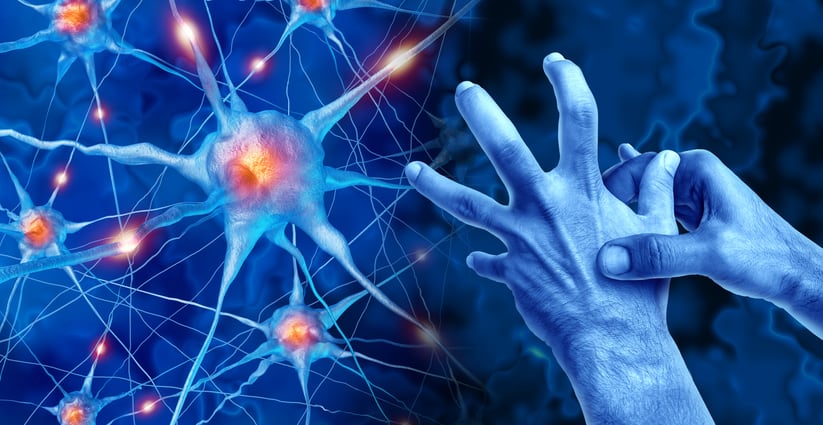
Essential tremor is a common neurological condition characterized by uncontrollable shaking, most often in the hands. The condition isn’t life-threatening but can interfere with everyday tasks like eating, writing or using a phone. For many patients, it significantly affects independence and quality of life.
Across the United States, an estimated seven to 10 million people live with essential tremor. Yet many people are never formally diagnosed, while others struggle to find a treatment that works for them.
Most patients begin treatment of essential tremor with medication, including beta blockers or antiseizure drugs. While these medications can reduce shaking for some, many patients report limited relief or stop treatment due to side effects like fatigue, dizziness, or mental fog.
For more severe cases, treatment options include deep brain stimulation—a surgical procedure that includes the placement of a pacemaker-like battery pack—and focused ultrasound, an MRI-guided non-surgical treatment option. Providence Swedish was a pioneer in the use of focused ultrasound for the treatment of essential tremor and is home to the Pacific Northwest’s first focused ultrasound program.
“Swedish provides a full suite of tremor treatment, including medication, surgical treatment and this technology which can be worn on the wrist,” says Pravin Khemani, M.D., medical director of the Movement Disorders Program at the Swedish Neuroscience Institute.
Also available to Providence Swedish patients is another non-surgical, drug-free option, the Cala kIQ, a prescription, wrist-worn device that delivers gentle electrical stimulation to specific nerves in the wrist that connect to the brain’s tremor circuits. Using TAPS, an innovative neuromodulation therapy, the Cala kIQ interrupts abnormal signals to the brain, temporarily reducing hand tremor.
|
TAPS therapy, delivered through the Cala kIQ® System, is the first and only clinically proven, FDA-cleared, non-invasive treatment that delivers personalized stimulation at the wrist to provide tremor relief throughout the day for people with essential tremor and Parkinson's disease. The Cala kIQ System is physician-prescribed and clinically proven to safely and effectively reduce action hand tremors. |
|

Judy, a Providence Swedish patient who asked that we not use her full name, was struggling with tremors associated with Parkinson’s disease. She avoided eating with friends and felt self-conscious doing everyday tasks like using a computer or writing her name to sign in at a volunteer position.
“Judy, like many of our patients, has decided to use the Cala kIQ system,” says Dr. Khemani. “It has been very helpful for her in restoring basic tasks like writing, eating or drinking from a cup or glass, which were quite challenging for her before treatment.”
Each session lasts 40 minutes and is personalized to the user’s tremor pattern. Clinical studies show that about nine out of 10 users experience meaningful tremor reduction, with relief often lasting one to two hours after treatment.
Judy chose the Cala device because it is noninvasive, can be used at home, and doesn’t involve medication. The on-demand design allows patients like Judy who want flexibility to time sessions before meals, work, or social events—helping them stay active and independent.
The Cala kIQ may not be appropriate for every patient. The device is not a cure, and its effects are temporary. Some users experience mild side effects such as skin irritation or tingling at the wrist. Insurance coverage varies, and out-of-pocket costs may apply. As with all essential tremor treatments, results vary from person to person.
“The Cala kIQ device is not suitable for everyone and we work with every patient to help them decide which is the right choice for them based on lifestyle, overall health and other considerations,” says Dr. Khemani. “Patients with pacemakers or other implanted electrical devices are not candidates for the Cala kIQ. Nor are pregnant patients or patients with epilepsy. We make sure that we help select the right candidates for the best possible outcomes.”
For people living with essential tremor, Cala adds a new, nonsurgical option for managing symptoms. While it won’t replace medication or surgery for everyone, it may offer meaningful, on-demand relief for those looking to better manage tremors in daily life.
Find a physician or advanced practice clinician (APC)
Our experts at the Swedish Neuroscience Institute offer comprehensive, progressive diagnosis and treatment for a wide range of spine, brain and central nervous system conditions. Telehealth options are available. Visit us on the web or call 206-320-3940. You can also use our provider directory to find the doctor that’s right for you.
Swedish Virtual Care connects you face-to-face with a nurse practitioner who can review your symptoms, provide instruction, and follow up as needed. If you need to find a provider, you can use our provider directory.
Additional resources
Struggling with essential tremor? Learn how focused ultrasound can help you.
Three sisters find hope at the Swedish Neuroscience Institute
Hope’s next chapter: three sisters continue their remarkable focused ultrasound journey
What is deep brain stimulation?
This information is not intended as a substitute for professional medical care. Always follow your health care professional’s instructions.
The Providence app offers world-class health care with human connection
Follow us on Facebook, Instagram and X.
About the Author
More Content by Swedish Neuroscience Team


