

[6 min read]
In this blog:
- Superior Canal Dehiscence Syndrome (SCDS) is a rare inner ear condition that affects hearing and balance.
- Surgery to repair the condition requires draining the spinal fluid and replacing the portion of bone cut from the skull with a metal plate.
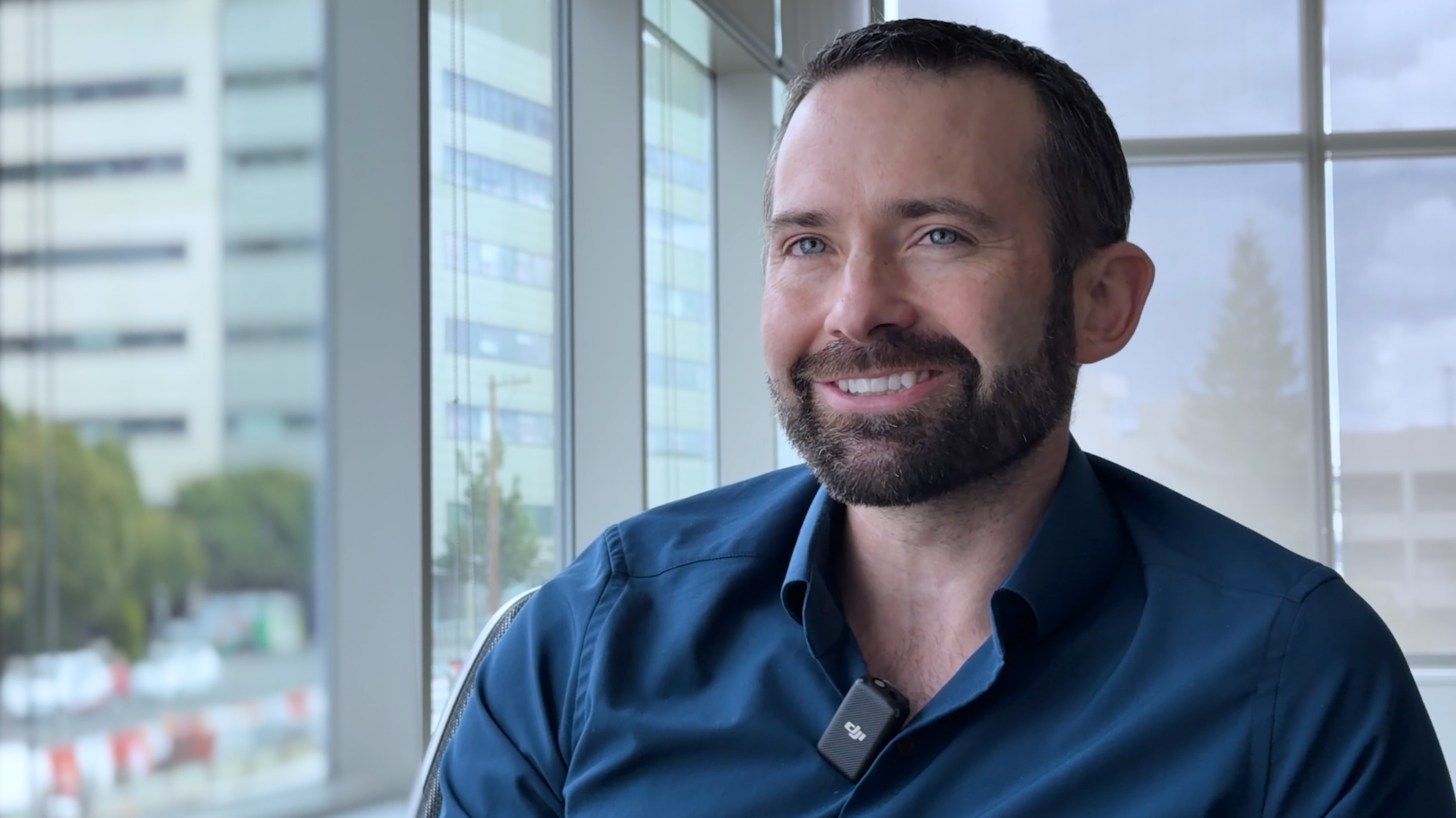
- Watch the video to meet a Providence Swedish leader whose surgery for SCDS relieved his symptoms and gave him a new appreciation for the work our caregivers do every day.
As Senior Director of Infection Prevention for Providence Swedish's North Division, Evan Sylvester spends his days making sure that hospitals are the safest environments possible. Whether it’s a patient with the flu in the ER or someone undergoing a complex heart surgery, Sylvester is committed to their safety. He’s so committed, in fact, that he admits to being slightly flabbergasted when he became a Providence Swedish patient.
It all began with strange visual vibrations triggered by loud sounds.
“I first noticed it at a Mariners baseball game when the crowd began cheering. As you can imagine, my two young children and dog at home made this symptom occur more frequently. I learned to manage much of it by wearing ear plugs,” says Sylvester.
A battery of tests and, finally, an answer
“What began as occasional symptoms gradually affected my everyday life,” says Sylvester. “Over five months, I completed 12 different appointments, multiple tests, and referrals before my care team identified the cause of my symptoms: Superior Canal Dehiscence Syndrome (SCDS), a rare inner ear condition that affects hearing and balance.”
"Behind every metric is a patient and a family navigating uncertainty." - Evan Sylvester, Senior Director of Infection Prevention for Providence Swedish, North Division
SCDS is caused by an opening in the bone covering the superior semicircular canal of the inner ear. This opening disrupts normal hearing and balance signals and may be present at birth or develop later in life from trauma.
Common SCDS symptoms can affect:
• Hearing: autophony (hearing your own voice loudly), sensitivity to sound, and hearing internal body sounds such as a heartbeat or footsteps.
• Balance: vertigo, dizziness, imbalance, and oscillopsia (visual disturbances with movement), often triggered by pressure changes.
• Mood and Cognition: brain fog, headaches, anxiety, or depression.
SCDS can be rooted in several factors:
• Congenital bone thinning or incomplete development of the canal covering.
• Head trauma or injury that triggers symptoms.
• Increased intracranial pressure that may gradually wear down the bone.
Sylvester was referred to Executive Medical Director of Neurosurgery and Neurosciences at the Providence Swedish Neuroscience Institute (PSNI), Zachary Litvack, M.D.
“Dr. Litvack’s experience with SCDS gave me confidence in moving forward with treatment,” says Sylvester. “While the decision to undergo surgery was difficult, it was the right choice.”
Sylvester’s three-hour surgery required draining his spinal fluid, replacing the portion of bone cut from the skull using a metal plate and screws and stitching closed the skin flap to complete the surgery.
“Evan's case was what I would consider quote-unquote routine. While it required opening the skull to get to the semicircular canal in order to repair it and restore the separation between the inner ear and the cranial compartment, we are navigating inside the skull outside the lining around the brain, or the dura, and never have to see or directly manipulate the brain,” says Dr. Litvack. “Our skull base surgery team at has become quite experienced and adept at these cases, and we can routinely get through most surgeries in 90-120 minutes with most patients going home the next day.”
Dr. Litvack also credits collaboration among subspecialty partners in ENT such as Neuro-Otologist Sachin Gupta, M.D., and access to the advanced diagnostic testing necessary to confirm diagnoses and offer appropriate treatment for patients like Sylvester.
Learning how to be a patient
“One thing that I counsel all of our patients undergoing this surgery is that we are going to make many of the symptoms worse for the first 24-72 hours after surgery. This has to do with the plugging and repair of the canal. It can trigger vertigo and double vision. The other thing for patients to keep in mind is that there is a small risk of permanent hearing loss, but in the vast majority of cases everything goes as planned without complications, and patients are happy with the results,” Dr. Litvack advises.
Ultimately, Sylvester was indeed happy with his outcome, but getting there was a journey. Though stepping away from work was almost as challenging as his surgery, Sylvester is grateful for leaders and a team who encouraged him to focus on recovery.
“What affected me most was experiencing Providence Swedish from the patient side of the bed. I often see data, policies and outcomes,” says Sylvester. “As a patient, I experienced something different: exceptional care. From pre-op through the ICU and recovery, every caregiver demonstrated professionalism, compassion, and kindness. The experience was humbling and inspiring.”
While Sylvester’s recovery was typical in many ways, it was still more challenging than he expected.
“I love hiking, trail running, fishing and staying active, needing help to walk, carry groceries, or accomplish simple daily tasks was challenging,” Sylvester admits. “There were days when the vertigo was so severe that even a short walk felt impossible. Thankfully, my physical therapy teams prepared me. They were instrumental in helping me retrain my brain, restore my balance and gradually regain my hearing.”
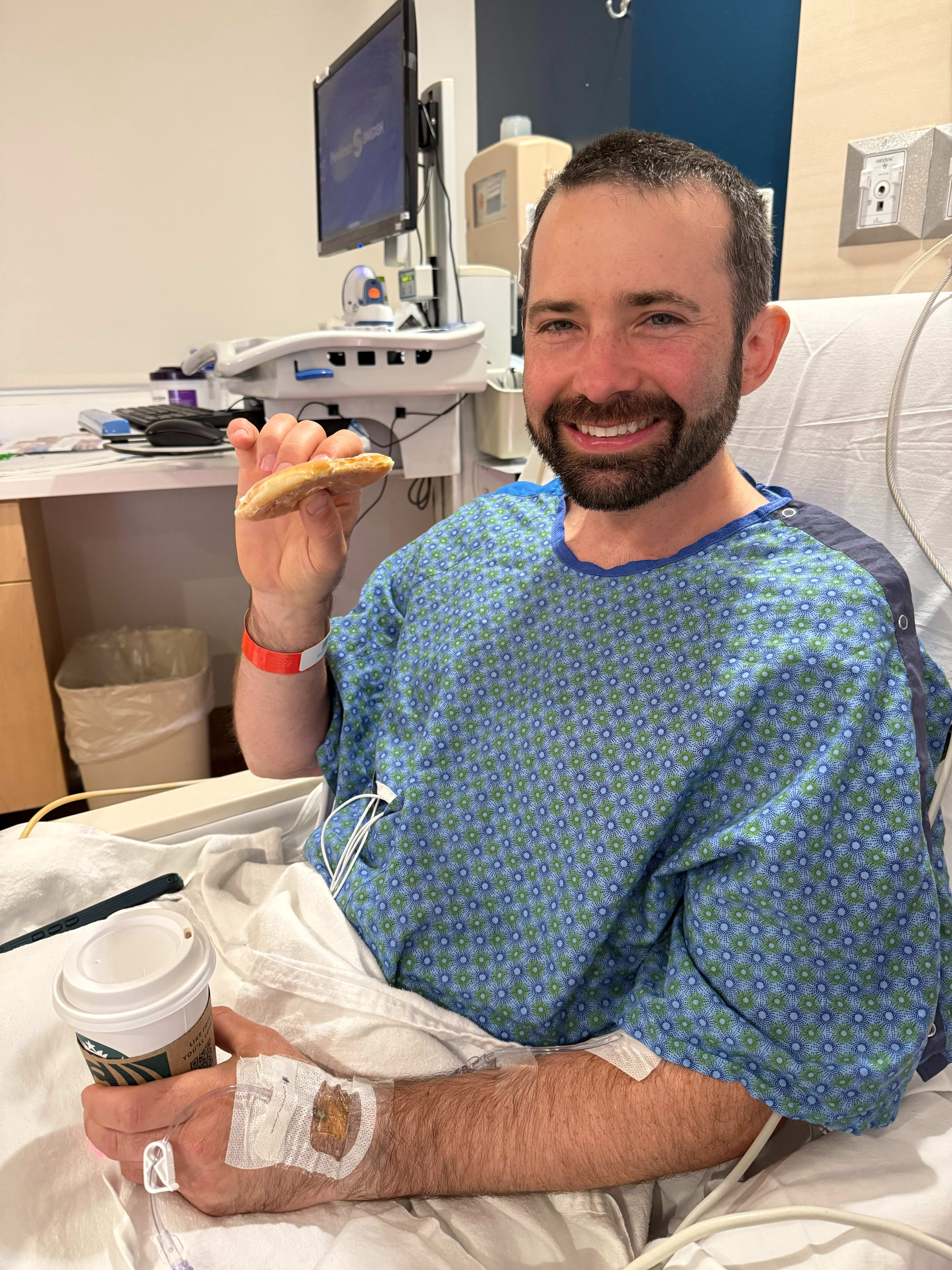
Because surgeons had to cut through Sylvester’s jaw muscles, he faced significant pain and limited ability to open his mouth during his initial post-op period.
“Anyone who knows me knows I have a weakness for a good donut, so one of my small victories in the hospital was carefully squishing one flat enough to fit in my mouth. That moment felt like a return to normal and a reminder that recovery happens one small win at a time,” says Sylvester, shown in photo above with a squished, but still deliecious donut.
Recovery felt like a marathon — with friendship bracelets
Losing so much of physical ability literally overnight — and then slowly rebuilding it — required a great deal of patience. His long list of recovery activities and a “vacation” quickly went out the window. Getting well would not be a sprint. He spent a lot of time with his two young daughters making friendship bracelets, crocheting, creating rock art and woodwork.
 “By the end of six weeks, my children hated artwork, and my partner was convinced there would be no unpainted rocks left in our yard. (See photo at right.) I also drove them a little crazy, when I reorganized the whole kitchen, and quickly forgot where I put everything,” he jokes. “But in many ways, the surgery forced me to slow down for the first time in my life. While it wasn't the vacation I had imagined, it gave me the opportunity to embrace a different pace, rediscover reading, and focus on recovery and spend time with my family—something I ultimately needed.”
Sylvester says that being on the receiving end of care reinforced something that’s sometimes forgotten in the busy days of working in healthcare: every patient has a story, fears, hopes, and challenges that may not be visible. Behind every metric is a person and a family navigating uncertainty.
“I spend much of my time focused on safety measures, quality outcomes, and evidence-based practices. Experiencing care as a patient gave those metrics a more personal meaning,” Sylvester shares thoughtfully. “Everything we do represents a commitment to protecting someone who is placing their trust in us. Experiencing that vulnerability firsthand gave me an even deeper appreciation for the work our caregivers do every day.”
Watch the video to meet Evan Sylvester to learn more about his remarkable journey from leader to patient at Providence Swedish.
Learn more and find a physician or advanced care practitioner (ACP)
Our experts at the Swedish Neuroscience Institute offer comprehensive, progressive diagnosis and treatment for a wide range of spine, brain and central nervous system conditions. Telehealth options are available.
Whether you require an in-person visit or want to consult a doctor virtually, you have options. Contact Swedish Primary Care to schedule an appointment with a primary care provider. You can also connect virtually with your provider to review your symptoms, provide instruction and follow up as needed. And with Swedish ExpressCare Virtual you can receive treatment in minutes for common conditions such as colds, flu, urinary tract infections and more. You can use our provider directory to find a specialist or primary care physician near you.
Information for patients and visitors
Additional resources
Providence Swedish is expanding neurological services on the Eastside
Transient ischemic attacks: 10 things every patient should know
Rehabilitation medicine helps patients get back to the business of living, one step at a time
Learn BE FAST, because every second counts during a stroke
Providence Swedish is nationally recognized for providing high-quality stroke care
This information is not intended as a substitute for professional medical care. Always follow your health care professional’s instructions.
Follow us on Facebook, Instagram and X.
The Providence app offers world-class health care with human connection
About the Author
More Content by Swedish Neuroscience Team


